
Wisdom Teeth Removal in Durham, NC: Complete Guide
Wisdom teeth (Third Molars) begin to develop several years before they need to be evaluated to determine surgical intervention (extraction) vs. continued monitoring. Not every third molar needs to be extracted, but considerations must be made regarding arch space, positioning, path of eruption, presence of pathology (E.g. cyst or enlarged dental follicle), presence of caries (decay), infection, pericoronitis, adjacent anatomy (E.g. IAN), periodontal damage or risk to adjacent teeth (E.g. second molars), and patient’s desires regarding the prospective procedure.
When arch space allows, the third molars are caries free, the patient has excellent oral hygiene (cleaning the third molars can be a challenge if space is not abundant), and the patient has keratinized gum tissue surrounding the third molars we commonly recommend continued monitoring.
When the patient does not have room in the arch for the teeth to erupt, has decay on the third molars, has an ectopically positioned tooth (E.g. mal-positioned impaction), has what appears to be associated pathology radiographically (Biopsy may be indicated at time of extraction), has either acute or chronic infection of the area (commonly swelling with a bad taste or bad smell noticed by the patient), has signs that lead us to believe the second molar is in future danger of being compromised periodontally or by root surface decay (common with horizontal impactions), or has eruption pain and desires treatment we commonly recommend surgical extraction. (Moderate Sedation is commonly requested for this procedure)
Many ask at what age should I get my wisdom teeth removed? This question can be answered by explaining tooth development. It is not the patients age that we use to determine ideal timing. Everyone’s teeth develop differently, some patients may may third molars we consider having 2/3 root development at age 15 y/o while others this may not occur until 21 y/o. We use radiographic evidence to determine when root development is ideal to give the patient the lowest risk of post operative complications (a tooth with roots considered 2/3 developed is what we think is “ideal”). By not letting the tooth fully develop, it commonly allows for a more efficient surgery which translates into less risks for the patient. The longer it takes for each extraction, the most risk each site has for post-op complications (E.g. increased post-op pain, nerve injury, and infection).
For patients who wait until pain motivates them to get evaluated, they run the risk of having wisdom teeth with fully developed roots, this may lead to a more intimate relationship with adjacent anatomy (E.g. Inferior Alveolar Nerve). Waiting until the tooth is fully developed to get it extracted can increase your risk of nerve damage after an extraction (Coronectomy may be recommended).
It is best to get evaluated as early a possible to ensure you have room in your jaw bones for your wisdom teeth to erupt into place without causing harm. For patients who do not have enough room or have some of the issues we talked about above (infection, mal positioning, pathology, pain, or decay) it is best to address with well timed surgical extractions (when the roots are partially developed).
We are accepting new patients. Become a patient today and get your third molars evaluated during your next cleaning and exam appointment.
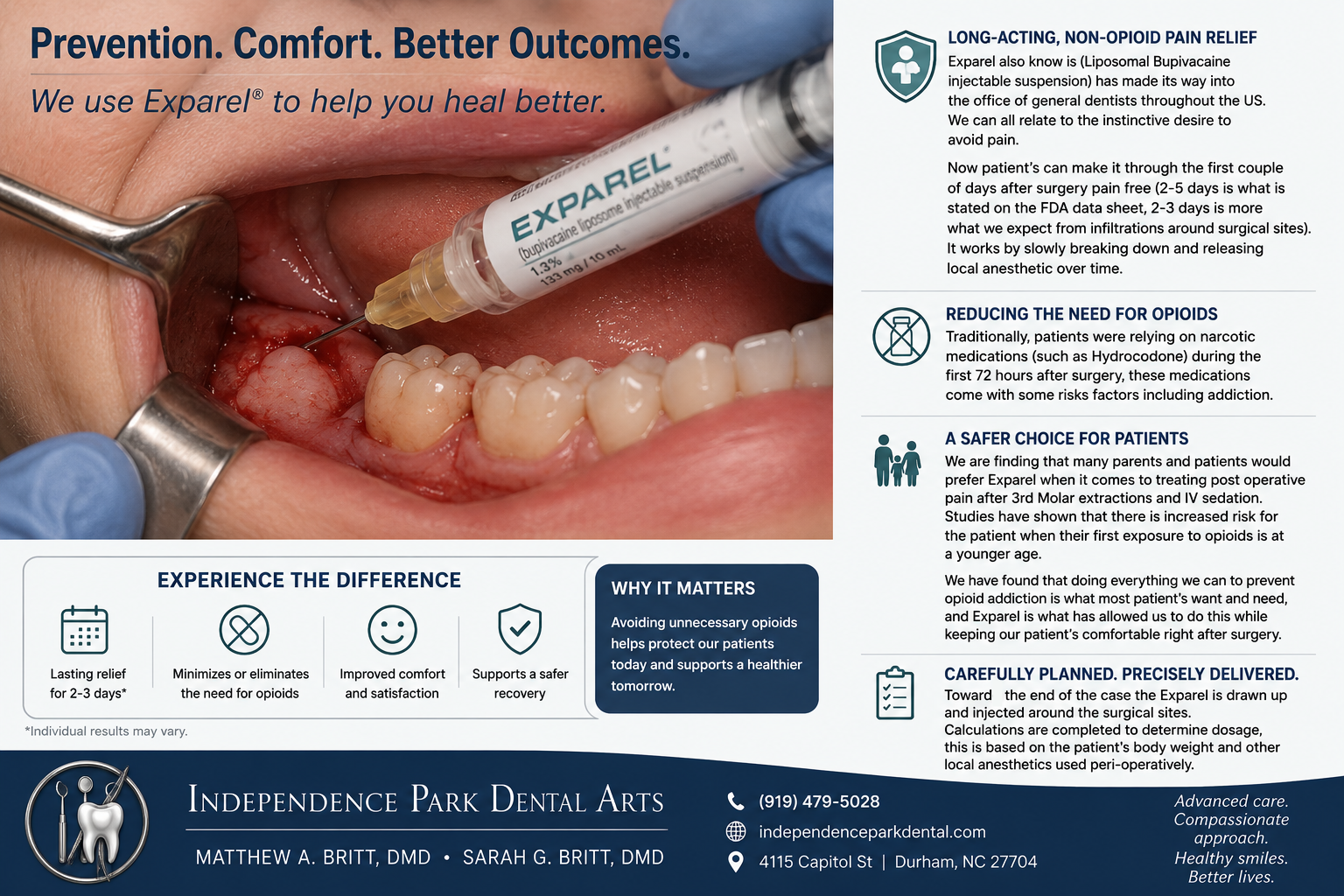
Using Exparel to avoid post-operative discomfort
Exparel also know is (Liposomal Bupivacaine injectable suspension) has made its way into the office of general dentists throughout the US. We can all relate to the instinctive desire to avoid pain. Now patient’s can make it through the first couple of days after surgery pain free (2-5 days is what is stated on the FDA data sheet, 2-3 days is more what we expect from infiltrations around surgical sites). It works by slowly breaking down and releasing local anesthetic over time. Traditionally, patients were relying on narcotic medications (such as Hydrocodone) during the first 72 hours after surgery, these medications come with some risks factors including addiction.
We are finding that many parents and patients would prefer Exparel when it comes to treating post operative pain after 3rd Molar extractions and IV sedation. Studies have shown that there is increased risk for the patient when their first exposure to opioids is at a younger age. We have found that doing everything we can to prevent opioid addiction is what most patient’s want and need, and Exparel is what has allowed us to do this while keeping our patient’s comfortable right after surgery.
Towards the end of the case the Exparel is drawn up and injected around the surgical sites. Calculations are completed to determine dosage, this is based on the patient’s body weight and other local anesthetics used peri-operatively.